

A single spark in a Zone 1 environment isn't just an equipment failure; it's a catastrophic safety breach. You understand the pressure of maintaining strict compliance with the latest ATEX Directive 2014/34/EU and the May 2026 regulatory updates. It's frustrating when poor visibility or equipment failure in wet, oily conditions stalls a critical inspection. You need tools that survive industrial drops and provide clarity in the darkest confined spaces.
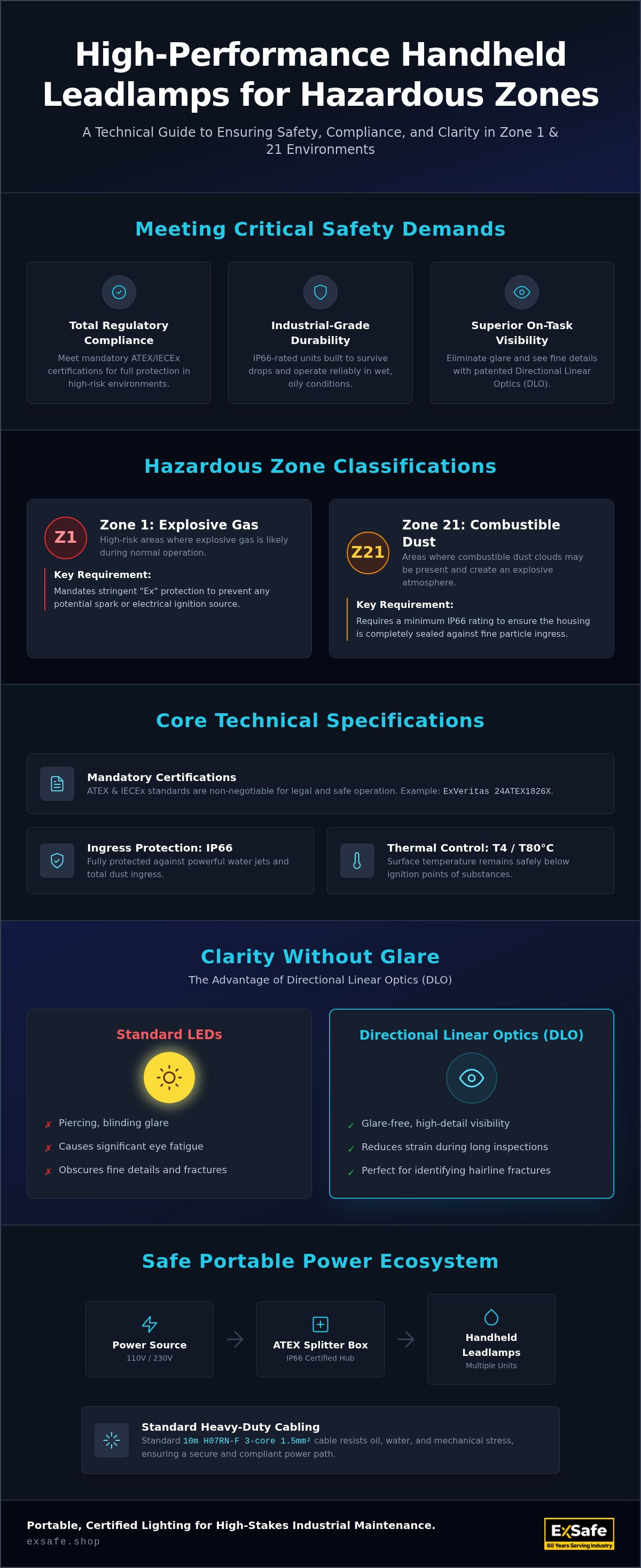
This guide teaches you how to select high-performance handheld leadlamps that ensure total regulatory compliance and superior visibility. You'll learn how patented Directional Linear Optics (DLO) eliminate glare and why portable lighting is the only reliable choice for high-stakes maintenance. We'll preview the essential specs for Zone 1 and 21 environments, from IP66 ratings to robust cable requirements, ensuring your team stays safe and productive.
Key Takeaways
- Understand the mandatory requirements for ATEX/IECEx certification to ensure full regulatory compliance in Gas Zones 1 and 2 and Dust Zones 21 and 22.
- Identify the technical criteria for selecting handheld leadlamps that offer IP66-rated durability and the robustness to survive industrial drops in harsh conditions.
- Learn how patented Directional Linear Optics (DLO) improve inspection accuracy by providing high-detail visibility while eliminating glare in confined spaces.
- Master the integration of portable lighting into safe power ecosystems using certified splitter boxes and standard 10m H07RN-F flexible cabling.
Understanding Certified Handheld Leadlamps for Hazardous Zones
Handheld leadlamps are critical portable lighting units engineered for close-up inspection in volatile environments. They aren't just torches; they're precision safety tools. Explosion protection is a legal mandate where flammable gases or combustible dust are present. Failure to use certified equipment can lead to catastrophic ignition in high-risk zones.
ATEX and IECEx certifications provide the technical assurance that a device won't act as an ignition source. These standards classify hazardous locations to ensure equipment matches the specific risk profile of the site. ExSafe specializes in portable lighting to provide maximum flexibility during maintenance shutdowns or offshore inspections. Portable units allow technicians to bring high-intensity light exactly where it's needed, ensuring no detail is missed in confined spaces.
Zone 1 and Zone 21 Compliance Requirements
Zone 1 represents high-risk areas where explosive gas atmospheres are likely to occur during normal operation. For these environments, equipment must meet stringent "Ex" protection standards to prevent sparks. Zone 21 covers areas with combustible dust clouds. This requires IP66 ingress protection to prevent fine particles from entering the housing and causing internal failures.
Reliable handheld leadlamps must also control thermal output. A T4 temperature class or T80°C rating ensures the unit's surface remains cool enough to avoid igniting surrounding substances. ExSafe's temporary lighting solutions, like the TY-300, meet these exact certification requirements. This specific model holds the ExVeritas 24ATEX1826X certification, providing the documented safety levels required for petrochemical and offshore sites.
Technical Selection Criteria: Optics, Power, and Durability
Selecting handheld leadlamps requires more than checking a box for ATEX compliance. Industrial inspection demands light quality over raw brightness. While lumens measure total light output, lux determines the intensity at the specific work surface. High lumen counts are useless if the beam is scattered or creates excessive glare. Compliance with OSHA lighting regulations ensures that portable illumination is both safe and functional for hazardous maintenance tasks.
The Role of Directional Linear Optics (DLO)
Standard LEDs often produce a piercing, blinding effect; it's a common cause of eye fatigue in confined spaces. Patented Directional Linear Optics (DLO) solve this by delivering high lumen output without the glare. It's vital for identifying hairline fractures or reading small serial numbers on complex machinery. The TY-300 series, featured in our temporary lighting range, offers two primary variants: an 18W model providing approximately 1005 lumens and a 26W version delivering roughly 1390 lumens. Both options prioritize light quality to ensure inspection accuracy.
Site power availability dictates your choice between 110V and 230V models. Reliable handheld leadlamps must offer voltage flexibility to integrate into existing power distribution systems. Durability is equally critical. Equipment must survive industrial drops while remaining light enough for long shifts. A weight range of 1.6kg to 2.0kg is the ideal ergonomic balance, reducing technician strain during extended inspections. If you need assistance determining the best configuration for your facility, speak with our technical team today for expert guidance on portable lighting solutions.
Integrating Leadlamps into Portable Power Systems
Industrial safety doesn't end at the light fixture. Handheld leadlamps must integrate into a fully certified power ecosystem to maintain site integrity. Managing cable clutter is essential for confined space safety and technician mobility. Our standard equipment includes exactly 10m of H07RN-F 3-core flexible 1.5mm² cable. This heavy-duty cabling resists oil, water, and mechanical stress. It ensures the electrical path remains secure in the harshest industrial environments.
Using ATEX Splitter Boxes allows you to power multiple handheld leadlamps from a single source safely. This configuration reduces the need for multiple long cable runs. It also prevents ignition risks associated with improper extension cord use or non-certified junctions. Every component in the power chain must meet IP66 standards. This rating ensures the system remains water-jet and dust-tight during rigorous cleaning or heavy weather. A single weak link in the power distribution can compromise the entire zone's safety.
Splitter Box and Cable Configuration
The Wolf ATEX Splitter Box provides a central hub for portable lighting. It supports units like the TY-300 and SP-600 efficiently. Compatibility is paramount for global operations. You must ensure all plugs match your site's specific socket infrastructure before deployment. We provide options for ATX, CEAG, Marechal, and Stahl Ex plugs to maintain a seamless, safe connection.
Explore the full range of system components in our ExSafe Portable Power Collection. Selecting the right distribution hardware prevents unnecessary downtime. It also ensures full regulatory compliance across your facility. Don't compromise on the power chain. Reliable distribution is the technical foundation of every safe inspection task.
Optimizing Hazardous Zone Visibility
Maintaining safety in explosive industrial environments requires a disciplined approach to equipment selection. Effective handheld leadlamps must offer more than just a rugged exterior. They require ATEX and IECEx certification for Zone 1 and 21 to ensure complete protection against gas and dust ignition. Patented glare-reduction optics provide the high-detail visibility necessary for accurate inspections without causing eye fatigue. Robust IP66-rated construction ensures your equipment survives the wet, oily, and high-impact conditions of the field.
Selecting the right portable lighting is a critical step in your facility's safety protocol. Don't leave compliance to chance. Our technical specialists are ready to help you configure a certified lighting system that meets your specific operational needs. Request a Quote for ATEX Handheld Leadlamps today to secure your site's safety. We're here to support your commitment to industrial excellence.
Frequently Asked Questions
What is the difference between an inspection light and a leadlamp?
Handheld leadlamps and inspection lights are essentially the same equipment in industrial settings. A leadlamp traditionally refers to a corded portable light used for maintenance tasks. An inspection light describes the specific function of providing high-detail visibility in confined spaces. Both must meet strict ATEX/IECEx standards when used in hazardous zones to prevent ignition risks during critical work.
Can I use the TY-300 leadlamp in both gas and dust environments?
Yes, the TY-300 is certified for use in both gas and dust atmospheres. It meets the requirements for Gas Zones 1 and 2 with a T4 temperature class. It also complies with Dust Zones 21 and 22 standards, featuring a maximum surface temperature of T80°C. This dual certification ensures safety across petrochemical and processing facilities where multiple hazards exist.
What type of cable is required for ATEX-certified leadlamps?
ATEX-certified leadlamps require heavy-duty, flexible cabling designed for harsh industrial use. The TY-300 is supplied with 10m of H07RN-F 3-core flexible 1.5mm² cable as standard. This specific cable type is oil, water, and chemical resistant. It's engineered to withstand the mechanical stresses of confined space work while maintaining electrical integrity in potentially explosive environments where safety is paramount.
Are these handheld leadlamps suitable for offshore use?
These handheld leadlamps are specifically engineered for the demanding conditions of offshore platforms and FPSO vessels. The TY-300 features a robust IP66-rated enclosure that protects against powerful water jets and heavy seas. Its corrosion-resistant construction and global ATEX/IECEx certifications make it a dependable tool for maritime maintenance where salt spray and explosive gases are constant operational risks.