

A single spark in a Zone 1 environment isn't just a mechanical failure; it's a catastrophic safety breach that can end operations instantly. You understand the constant pressure of maintaining strict safety standards while managing airflow with a certified explosion proof axial fan. The fear of non-compliance during a rigorous safety audit is a heavy burden for any facility manager. Equipment failure in corrosive or explosive atmospheres is simply not an option for your operation.
This guide ensures you master the technical specifications and compliance requirements necessary for selecting high-performance ventilation hardware. You'll learn how to achieve full regulatory compliance while ensuring optimal airflow for worker safety. We'll examine the latest 2026 ATEX and IECEx updates, precise CFM calculations for large volumes, and the durability required for long service lives. By the end, you'll understand why choosing certified portable hardware is the most effective way to secure your hazardous industrial zones against unpredictable risks.
Key Takeaways
- Learn how to calculate precise CFM and static pressure requirements to select the most efficient explosion proof axial fan for high-volume portable ventilation.
- Master the critical distinctions between Zone 1 and Zone 2 classifications to ensure your portable hardware maintains full regulatory compliance.
- Identify robust design features like anti-static blades and corrosion-resistant housings that extend the service life of your ventilation equipment.
- Simplify the procurement process for ATEX and IECEx certified hardware using a streamlined quote-request system designed for industrial facility managers.
Understanding the Role of an Explosion Proof Axial Fan
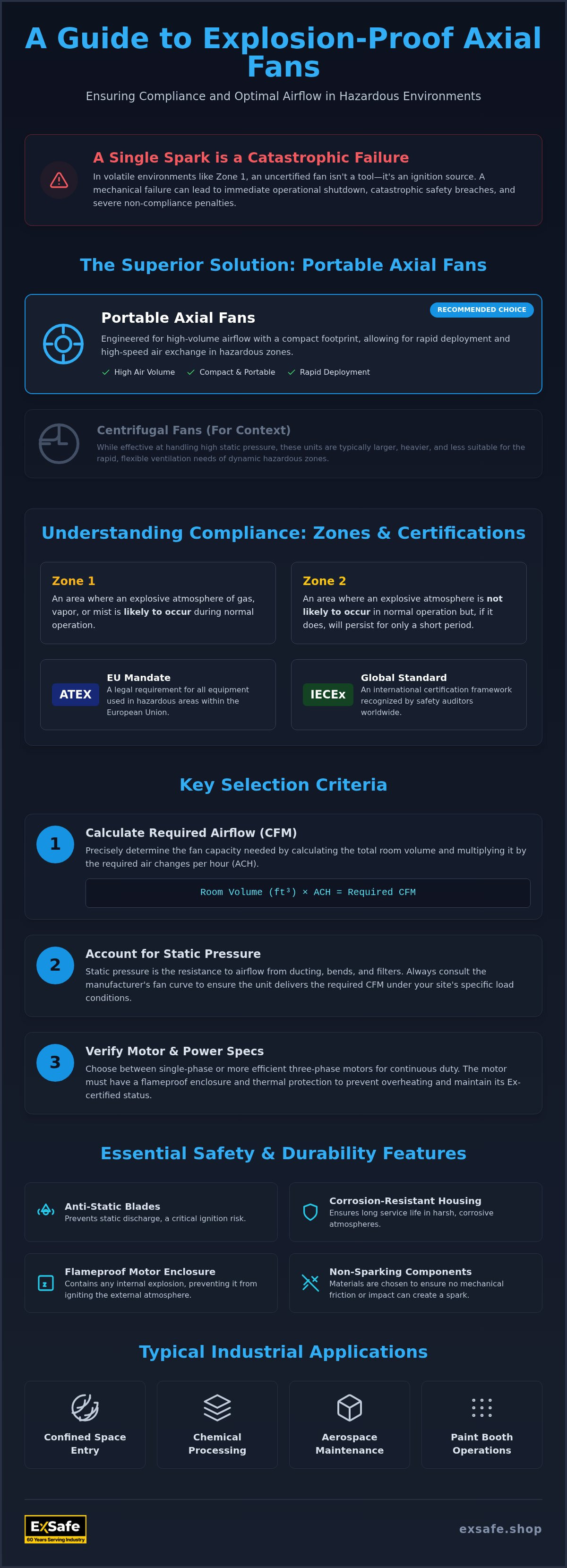
An explosion proof axial fan is a specialized ventilator engineered to eliminate ignition sources in volatile environments. It prevents internal and external sparks through flameproof motor enclosures and non-sparking components. This is critical in areas where flammable gases, vapors, or dusts are present. This Axial Fan Design offers a distinct mechanical advantage by providing high-volume airflow within a compact, portable footprint.
Choosing axial over centrifugal designs is often a matter of physics and site requirements. While centrifugal fans handle high static pressure, axial fans move significantly more air relative to their size. For Zone 1 and Zone 2 safety, portable axial units are the superior choice. They allow for rapid deployment and high-speed air exchange without the weight of heavy centrifugal housing. You can explore certified options in our ventilation collection to see these principles in practice.
How Axial Airflow Works in Hazardous Zones
Air travels through the fan housing parallel to the motor shaft. This streamlined path allows for efficient, high-volume extraction. It's vital for preventing hazardous gas accumulation from reaching the Lower Explosive Limit. Non-sparking blade materials are a standard requirement. These materials ensure that mechanical friction or impact won't trigger an ignition event during operation.
Typical Use Cases for Industrial Ventilation
- Confined Space Entry: Maintaining continuous air exchange to protect workers from toxic or explosive buildup.
- Chemical Processing: Rapidly removing fumes in volatile areas like refineries or chemical plants.
- Aerospace Maintenance: Dissipating heat and flammable vapors in hangars or fuel tank environments.
- Paint Booth Operations: Extracting overspray and solvent vapors to maintain a safe working atmosphere.
In many oil and gas operations, ventilation is a core component of hot work safety protocols. If you are managing such a project, you may want to visit PetroHab LLC to learn about their modular Hot Work Safety Enclosures (HWSE) designed for these high-stakes environments.
Key Selection Criteria: Performance and Airflow Specs
Selecting an explosion proof axial fan requires a rigorous analysis of Cubic Feet per Minute (CFM) against the specific volume of your workspace. Facility managers must calculate the total room volume and multiply it by the required air changes per hour (ACH) to determine the necessary airflow capacity. Adherence to OSHA hazardous location standards ensures that these calculations meet legal safety thresholds for volatile environments. Accuracy here prevents the dangerous accumulation of combustible gases.
The Relationship Between CFM and Static Pressure
Static pressure is the resistance to airflow caused by ducting, bends, and environmental obstructions. As duct length increases or diameter decreases, static pressure rises, which forces the fan to work harder. In industrial ventilation, static pressure represents the internal friction and resistance that an axial fan must overcome to move air through a system. You must consult the manufacturer fan curve to verify that the unit maintains its rated CFM under the specific load of your anti-static flexible ducting setup.
Motor and Power Specifications
Industrial power grids typically offer single-phase or three-phase options. Three-phase motors provide higher efficiency for continuous-duty cycles in large-scale refineries. The motor enclosure itself must be flameproof to maintain its Ex-certified status. A high-performance explosion proof axial fan must balance these electrical demands with thermal protection to prevent overheating in stagnant air. Noise levels are also a critical factor; personnel safety requires fans with dB ratings that don't exceed permissible exposure limits during long shifts. If you have specific voltage requirements for your site, request a technical consultation to match hardware to your infrastructure.
Compliance and Certification: ATEX vs. IECEx
Deploying an explosion proof axial fan without verified certification is an unacceptable operational risk. ATEX and IECEx are the global benchmarks for hazardous area safety. ATEX is a legal mandate within the European Union, while IECEx certification provides a standardized international framework recognized by safety auditors worldwide. Using non-certified equipment in volatile zones isn't just dangerous; it leads to immediate regulatory fines and the loss of insurance coverage.
Zone 1 vs. Zone 2 Requirements
Zone 1 classifications apply to areas where explosive atmospheres are likely to occur during normal equipment operation. These environments demand high-integrity ventilation hardware that prevents ignition even during rare malfunctions. Zone 2 areas are lower risk, where explosive gases are only present occasionally or during abnormal events. Zone 1 equipment is always suitable for Zone 2, but not vice versa. For maximum safety, professionals often standardize on Zone 1 certified portable fans to ensure compliance across all work areas.
Temperature Classes and Gas Groups
Decoding Ex markings is essential for matching hardware to site-specific hazards. Temperature classes (T1-T6) define the maximum surface temperature the fan can reach. For example, T4 equipment stays below 135°C, which is critical for chemicals with low auto-ignition points. Gas groups further classify the volatility of the substances present:
- Group IIA: Less volatile gases like propane.
- Group IIB: Medium volatility gases like ethylene.
- Group IIC: Highly volatile gases like hydrogen and acetylene.
A high-performance explosion proof axial fan rated for IIC T4 provides the broad protection needed for most industrial applications. Always verify that your chosen hardware matches the specific gas and temperature requirements documented in your facility safety plan. This precision prevents equipment from becoming a catalyst for an explosion.
Design Features for Durability and Safety
High-performance hardware relies on material science to ensure operational safety in hazardous environments. An explosion proof axial fan must withstand physical impact and extreme environmental stress without compromising its protective integrity. Housing materials like cast aluminum provide essential spark resistance by dissipating heat quickly. Stainless steel is the industry standard for corrosive offshore or chemical processing environments. Blade design is equally important; anti-static materials prevent the buildup of dangerous static charges during high-velocity rotation. Aerodynamic efficiency is another factor; optimized blade profiles move more air with less energy, reducing the load on the motor. IP ratings, typically IP55 or higher, are non-negotiable for protecting internal electrical components from heavy dust and water ingress.
Spark-Resistant Construction
Non-ferrous materials are mandatory for preventing mechanical sparks during operation. If a blade strikes the housing, these specific alloys won't generate the heat required to ignite the surrounding atmosphere. Blade-to-housing clearance is a critical safety specification that manufacturers must strictly maintain. Precision engineering ensures that thermal expansion, vibration, or minor housing deformations won't cause mechanical contact. This level of mechanical reliability is vital for the long service life of your explosion proof axial fan in volatile zones.
Portability and Versatility
In hazardous zones, flexibility is a primary safety asset. Portable extraction fans allow for rapid deployment in confined spaces, aerospace hangars, or temporary maintenance areas. While some facilities consider permanent installations, mobile units provide a more adaptable ventilation strategy for evolving risks. A portable electric ventilator allows you to move safety equipment exactly where workers need it most. Essential features for rapid deployment include:
- Integrated handles and rugged wheels for manual transport.
- Quick-connect duct adapters for immediate setup.
- Compatibility with anti-static flexible ducting.
If you need a custom configuration for your facility, contact our technical team for a detailed quote.
Procuring Industrial Ventilation Solutions from ExSafe
ExSafe serves as a dependable partner for industries operating in high-stakes environments. We provide direct access to high-specification hardware that meets the most demanding safety protocols. Every explosion proof axial fan in our inventory carries authentic ATEX and IECEx certifications. This ensures your facility remains compliant with international standards while protecting your workforce from ignition risks. We prioritize industrial-grade quality over consumer-level compromises.
Expert Support for Complex Safety Requirements
Selecting the right hardware requires more than just browsing a catalog. Our team helps bridge the gap between complex regulatory mandates and physical hardware acquisition. We understand that ventilation doesn't work in isolation. Reliable power distribution must accompany your Ex-certified Ventilation collection to maintain a safe operational chain. Whether you're managing a refinery or an aerospace hangar, we provide the technical expertise to ensure your portable equipment integrates seamlessly into your safety plan.
Streamlined Quote and Procurement Process
Procurement for specialized industrial orders shouldn't be complicated. We utilize a quote-request system tailored for the efficiency facility managers require. This approach allows us to handle bulk orders and specialized technical requirements with precision. You won't find the surface-level support typical of mass-market retailers here. We offer rapid response times for critical safety equipment needs to prevent operational downtime. ExSafe provides national shipping across the United States, ensuring your explosion proof axial fan arrives ready for immediate deployment in Zone 1 or Zone 2 areas.
Securing Your Industrial Operations with Certified Ventilation
Maintaining safety in hazardous environments requires more than just moving air. It demands a precise balance of calculated CFM performance and uncompromising regulatory adherence. Selecting the correct explosion proof axial fan ensures your facility meets current 2026 ATEX and IECEx standards while protecting workers from volatile gas accumulation. By prioritizing industrial-grade durability and portable flexibility, you eliminate the risks associated with equipment failure in corrosive or explosive atmospheres. Our specialized support for Zone 1 and Zone 2 areas provides the technical assurance needed for complex industrial sites.
ExSafe is committed to delivering safety through verified certification and robust hardware. Don't leave your compliance to chance during your next safety audit. Our team is ready to assist with high-specification ventilation solutions tailored to your specific site hazards. Request a Quote for ATEX Certified Axial Fans to secure the reliable protection your team deserves. We look forward to supporting your next project with precision-engineered safety hardware.
Frequently Asked Questions
What is the difference between an axial fan and a centrifugal fan in hazardous zones?
Axial fans move air parallel to the motor shaft, while centrifugal fans redirect it at a 90-degree angle. Axial designs are preferred for high-volume, low-pressure applications like rapid air exchange in large industrial spaces. Centrifugal fans handle higher static pressure but are typically heavier and less portable. For Zone 1 and Zone 2 safety, portable axial units offer the best balance of airflow and maneuverability.
Can I use a Zone 2 axial fan in a Zone 1 area?
No, you cannot use Zone 2 rated equipment in a Zone 1 environment. Zone 1 areas have a higher probability of explosive atmospheres during normal operations, requiring more stringent protection concepts. While Zone 1 equipment is backward-compatible and safe for Zone 2, Zone 2 hardware lacks the secondary protection levels necessary for higher-risk zones. Standardizing on Zone 1 hardware ensures compliance across all volatile work areas.
How do I calculate the required CFM for my hazardous location?
Calculate CFM by multiplying the room's total cubic volume by the required air changes per hour (ACH), then dividing by 60. Industrial standards often recommend 10 to 20 air changes per hour depending on the specific chemicals present. Ensure the explosion proof axial fan you select can maintain this CFM against the static pressure of your ducting. Accurate calculations prevent the buildup of flammable vapors.
What materials are used to make a fan explosion-proof?
Explosion-proof fans utilize non-ferrous, spark-resistant materials like cast aluminum or specialized reinforced polymers for blades and housings. These materials prevent mechanical sparks if components make contact during operation. Motors are housed in flameproof enclosures to contain internal ignitions. Stainless steel is often used for external hardware in corrosive environments. Every component is engineered to eliminate potential ignition sources in volatile atmospheres.
Are ATEX certified fans required by law in the United States?
In the United States, OSHA and the NEC govern hazardous location equipment, typically using the Division system. However, many global organizations now accept IECEx and ATEX certifications as proof of high-level safety compliance. While the NEC is the primary legal framework, using ATEX-certified hardware often meets or exceeds local requirements. Always consult your Authority Having Jurisdiction (AHJ) to verify specific certification acceptance for your industrial site.
How often does an explosion-proof axial fan require maintenance?
Maintenance schedules depend on the environment, but a monthly inspection of the spark-resistant blades and motor enclosure is standard. You should check for dust accumulation, which can affect the T-rating by causing overheating. Inspect anti-static ducting for tears or clogs that increase static pressure. Regular testing of electrical connections ensures the explosion proof axial fan maintains its protective integrity throughout its industrial service life.
What is the significance of a T4 temperature rating on a fan?
A T4 rating indicates that the fan's maximum surface temperature won't exceed 135°C (275°F) under any operating conditions. This rating is critical because it must remain below the auto-ignition temperature of the specific gases present in your facility. Higher ratings like T5 or T6 offer even lower surface temperatures for more volatile substances. Matching the T-rating to your site chemicals is a fundamental safety requirement.
Do explosion-proof axial fans come with integrated ducting?
Most fans are sold as standalone units, but they feature integrated adapters for rapid duct attachment. It's essential to use certified anti-static flexible ducting to maintain the safety of the entire ventilation chain. These ducts prevent the buildup of static electricity caused by high-velocity air movement. Many portable kits include the fan, ducting, and storage canisters as a complete solution for confined space entry and fume extraction.