

The toughest-looking enclosure may still be the wrong choice for a hazardous area. A hazardous zone junction box must suit the classified atmosphere and the wiring task. An ingress-protection rating alone does not establish that equipment is suitable for an explosive atmosphere, so don’t treat a rugged or sealed appearance as proof of suitability.
Build the specification from the site conditions and the equipment’s function. Record the gas or dust classification, applicable zone, required protection details, temperature limits, and cable-entry requirements from approved project documents. This guide explains how to compare those requirements with product information and how to distinguish a junction box from a portable splitter box, which serves a different purpose.
Key Takeaways
- Define the hazardous zone junction box by its wiring-connection function before comparing enclosure options.
- Use approved project documents to record the area classification, gas or dust group, temperature details, and required equipment markings.
- Compare entries and configuration with the project requirements. Appearance alone does not demonstrate hazardous-area suitability.
- Distinguish junction boxes from portable power-distribution equipment. The Wolf ATEX Splitter Box serves a different function and is not a substitute.
Hazardous Zone Junction Box: Define Its Role Before Choosing Protection
A junction box houses electrical connections or terminations. Its role is to enclose those wiring connections, not to distribute power through multiple outlets. Define that function first, then compare equipment designed for that task. A box’s shape or rugged construction does not show whether it is suitable for a classified area.
Start with the site’s approved hazardous-area documentation. Zone 1 and Zone 2 refer to gas hazards; dust areas use separate designations, including Zones 21 and 22. These classifications are not interchangeable. Don’t infer dust suitability from a gas-zone marking or choose equipment based on a zone number alone. The classification, intended equipment function, and protection details must align. For background on hazardous locations and equipment protection approaches, see this overview of hazardous-area principles.
Why a weather-resistant box is not automatically hazardous-area equipment
Ingress protection describes resistance to the entry of solids or water. Hazardous-area certification addresses suitability for specified explosive-atmosphere conditions. One does not replace the other. A weather-resistant enclosure may protect against environmental exposure, but its appearance or ingress-protection rating alone does not demonstrate hazardous-area suitability.
For a hazardous zone junction box, compare the product’s documented markings and intended purpose with the project classification. Record the gas or dust designation, applicable equipment group, and temperature details where specified in the project documents. Then compare the protection information with those requirements. If the markings or stated purpose do not match the project documentation, the enclosure’s construction alone does not establish suitability.
How to Specify a Hazardous Zone Junction Box in a Practical Sequence
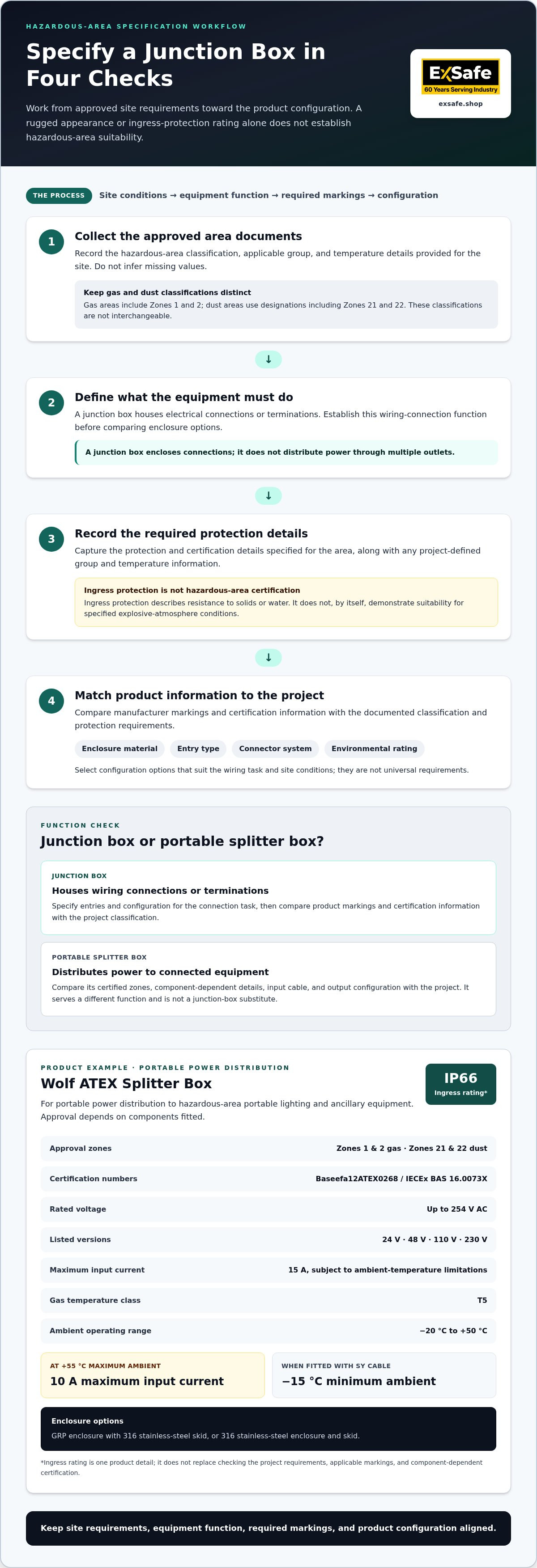
Work from site requirements toward product configuration. This sequence helps keep project requirements separate from the available enclosure options:
- 1. Collect area documents. Use approved project documentation to identify the gas or dust classification, applicable group, and temperature details. Don’t infer values that the documents do not provide.
- 2. Define the equipment function. State whether the enclosure will house wiring connections or perform another task. The function determines which product category to compare.
- 3. Record required markings. Capture the protection and certification details specified for the area. OSHA’s requirements for electric equipment provide U.S. context for equipment in hazardous locations.
- 4. Compare configurations. Match manufacturer markings and certification information to the project requirements. Record relevant options such as enclosure material, entry type, connector system, and environmental rating.
What information belongs in the equipment specification?
Separate site requirements from product options. The area classification and project-defined group or temperature details describe the application. Material, cable entries, and connector systems describe the product configuration. Include the options relevant to the task and site conditions rather than assuming they are universal requirements.
In brief: collect approved area documents, define the equipment function, record required markings, then compare product configurations. This is a specification workflow, not wiring instructions. Clear records also make it easier to identify a mismatch between the project requirements and a product’s stated purpose or markings.
For a related product category, explore hazardous-area power-distribution equipment.
Compare Hazardous-Area Equipment Without Confusing Junction and Splitter Boxes
Compare equipment by function first, then check its markings and configuration against the project. A hazardous zone junction box encloses wiring connections. A portable splitter box distributes power to connected equipment. The table highlights this difference and the information to compare during specification.
| Comparison point | Junction box | Portable splitter box |
|---|---|---|
| Function | Houses wiring connections or terminations. | Distributes power to connected equipment. |
| Markings | Compare product markings and certification information with the project classification. | Compare certified zones and component-dependent details with the project requirements. |
| Entries | Specify entries to suit the wiring task and product configuration. | Choose the listed input cable and output configuration that suit the application. |
| Configuration | Specify for the connection task and site conditions. | Portable power-distribution equipment for connected products. |
For U.S. projects, consult the applicable OSHA regulations for hazardous locations alongside the project documentation.
When a portable ATEX splitter box is a different solution
The Wolf ATEX Splitter Box provides portable power distribution for hazardous-area lighting and ancillary equipment. It is not a junction box or an interchangeable substitute. It is ATEX approved for Zones 1 and 2 gas and Zones 21 and 22 dust, depending on components fitted. Its certification numbers are Baseefa12ATEX0268/IECEx BAS 16.0073X.
The splitter box is rated up to 254 V AC, with versions listed at 24 V, 48 V, 110 V, and 230 V. Its maximum input current is 15 A, subject to ambient-temperature limitations. The gas temperature class is T5, and the ambient operating range is -20 °C to +50 °C. If the maximum ambient temperature needs to increase to 55 °C, the maximum input current is limited to 10 A. For a unit fitted with SY cable, the minimum ambient temperature is -15 °C.
The unit has an IP66 rating* and is available with a GRP enclosure and 316 stainless-steel skid, or a 316 stainless-steel enclosure and skid. Compatible plug and socket types include standard industrial hazardous-area variants. It can be ordered with a maximum of two internal fuses and/or output glands instead of sockets. Explore the compact ATEX splitter box or browse the hazardous-area power distribution collection.
* Depending on components fitted to the unit. This note applies to the dust classification and temperature details, including the maximum surface temperature of 90 °C*.
** If SY cable is fitted, minimum ambient temperature = -15 °C.
*** If max ambient needs to be increased to 55 °C the maximum input current is limited to 10 A.
**** Weight of units will vary with input cable length and type, and variations in components fitted. Nominal weight is 10 kg for the GRP version and 12 kg for the stainless-steel version.
All specifications are based on laboratory conditions; values are approximate and may vary. Specifications may change without prior notification.
Specify with the Project Requirements in View
A safe hazardous zone junction box specification starts with the equipment’s function, followed by the approved area classification and required protection details. Record the applicable gas or dust conditions, then compare the product markings and configuration with the project documents. Appearance alone is not evidence of suitability.
Keep equipment roles distinct. The Wolf ATEX Splitter Box is portable power-distribution equipment, not a junction-box substitute. Its certification numbers are Baseefa12ATEX0268/IECEx BAS 16.0073X, and its stated use covers Zones 1 and 2 gas and Zones 21 and 22 dust, depending on components fitted.
* Depending on components fitted to the unit. This note applies to the dust classification and temperature details, including the maximum surface temperature of 90 °C.
** If SY cable is fitted, minimum ambient temperature = -15 °C.
*** If max ambient needs to be increased to 55 °C the maximum input current is limited to 10 A.
**** Weight of units will vary with input cable length and type, and variations in components fitted. Nominal weight is 10 kg for the GRP version and 12 kg for the stainless-steel version.
All specifications are based on laboratory conditions; values are approximate and may vary. Specifications may change without prior notification. For hazardous-area power-distribution equipment, contact ExSafe about your requirements.
Frequently Asked Questions
What is a hazardous zone junction box?
A hazardous zone junction box encloses electrical wiring connections or terminations and must be documented as suitable for the relevant hazardous-area classification. Its purpose differs from power-distribution equipment, which supplies power to connected devices. Specify the box by its function, site classification, and required protection details. A rugged appearance or weather-resistant construction alone does not establish hazardous-area suitability.
Is a standard weatherproof junction box suitable for a hazardous area?
Weather resistance alone does not establish suitability. Ingress protection describes resistance to the entry of solids or water, while hazardous-area markings and certification address suitability for specified explosive-atmosphere conditions. Compare the equipment’s documented protection, intended use, and markings with the project classification. Don’t assume an enclosure is suitable because it looks sealed or robust.
How do I specify a junction box for Zone 1 or Zone 2?
Start with the approved project documents. Record whether the area is classified as Zone 1 or Zone 2, then capture any applicable gas group and temperature details stated for the project. Define the box’s wiring function and document the required protection markings. Compare those requirements with the manufacturer’s markings and certification information, including relevant entry, material, and configuration details. Don’t infer missing project values.
What is the difference between a junction box and an ATEX splitter box?
A junction box encloses wiring connections or terminations. An ATEX splitter box distributes power to connected equipment, so the two serve different functions and are not interchangeable. The Wolf ATEX Splitter Box provides portable power distribution for hazardous-area lighting and ancillary equipment. Choose the equipment category by task, then compare its documented markings and configuration with the project requirements.