

What if the certified motor on your ventilation equipment is actually creating a false sense of security? Many operators believe that an explosion-proof motor alone makes a hazardous area fan for chemical plants safe, but this misconception can lead to catastrophic asset loss. In an industry where a single ignition source can result in over $100 million in damages, relying on partial certification is a risk you cannot afford.
It's understandable to feel overwhelmed by the January 2026 ATEX guidelines and complex IECEx coding. We'll clarify these standards so you can distinguish between motor-only labels and full-unit certification like II 2 G Ex db eb IIB T6 Gb. This article uncovers five critical myths about portable ventilation safety. You'll learn how to ensure your facility remains compliant with the newest EPA regulations while protecting your team during high-risk maintenance tasks.
Key Takeaways
- Learn why full-unit ATEX certification is vital for the entire fan assembly, ensuring components like terminal boxes and blades are tested as a single safe system.
- Understand the necessity of conductive ducting with surface resistance ≤ 10⁶ Ω to prevent static electricity from becoming an ignition source in volatile areas.
- Discover how a portable hazardous area fan for chemical plants provides essential localized extraction for deep confined spaces and stagnant vapor pockets during maintenance.
- Gain technical clarity on exact certification strings like II 2 G Ex db eb IIB T6 Gb to ensure your equipment meets the latest 2026 safety standards.
Myth 1: An ATEX Certified Motor Makes the Entire Fan Safe
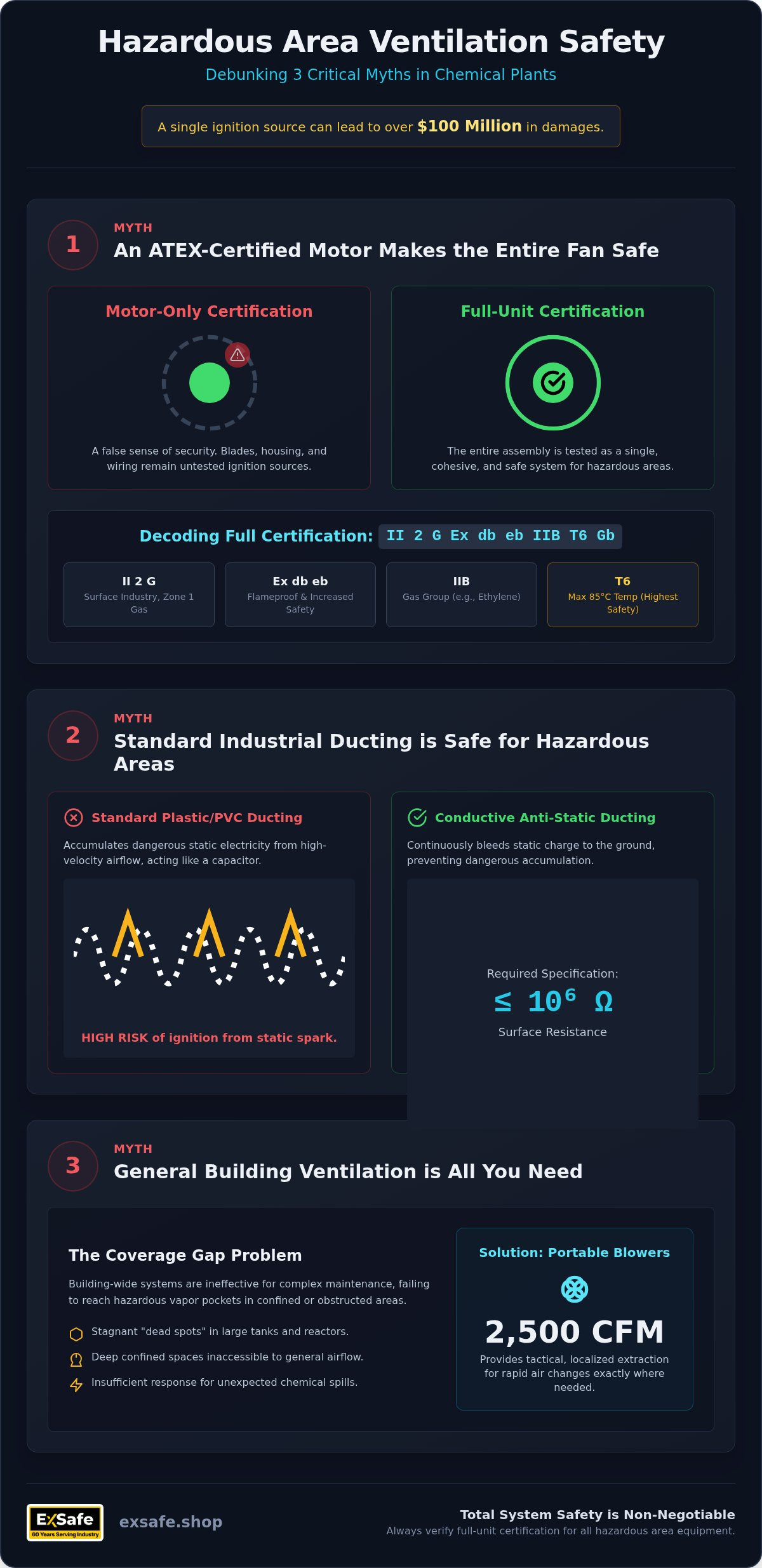
Safety in volatile environments is non-negotiable. Many procurement officers mistakenly assume that mounting an ATEX-certified motor onto a standard housing satisfies safety requirements. This is a dangerous fallacy. A hazardous area fan for chemical plants requires full-unit certification to ensure every component, from the terminal box to the fan blades, won't become an ignition source. It's a common error that creates a false sense of security while leaving your facility vulnerable to catastrophic ignition.
The ATEX directive mandates strict compliance for equipment used in explosive atmospheres. Following the Euramco Group standard, every part of a portable ventilator must meet hazardous location requirements. Non-certified fan blades are particularly risky. They can produce mechanical friction sparks if they strike the housing during operation. Without full-unit testing, you're operating with an unverified system. For guaranteed protection, you should only utilize certified ventilation like the EFi75xx. This unit is essential for chemical plant maintenance because the entire assembly is tested as a single, cohesive unit.
Understanding Full-Unit ATEX Certification Strings
Deciphering certification strings is vital when selecting a hazardous area fan for chemical plants. Take the string II 2 G Ex db eb IIB T6 Gb. The 'II 2 G' indicates suitability for Zone 1 surface industries. The 'T6' classification is the most stringent temperature rating; it limits surface heat to 85 °C. In chemical plants, where vapors often have low auto-ignition temperatures, a T6 rating provides the highest level of protection. Choosing a lower rating like T4 or T3 can be a fatal mistake. Don't compromise on these technical specifications; your team's safety depends on precision.
Myth 2: Standard Industrial Ducting is Sufficient for Hazardous Areas
Static electricity is a primary ignition source in chemical processing ventilation. When high-velocity air moves through a duct, friction generates a significant electrostatic charge. Standard plastic or PVC ducts are dangerous because they act as capacitors. They store static energy until it reaches a critical point and discharges as a high-energy spark. In an environment filled with volatile vapors, this single spark can cause a catastrophic explosion. Standard industrial ducting lacks the carbon-infused properties required to safely dissipate this energy.
Effective hazard control ventilation systems require specialized components to mitigate this specific risk. You must use conductive ducting with a surface resistance of ≤ 10⁶ Ω. This specification ensures that static charge is continuously bled off to the ground rather than accumulating on the duct surface. Pairing your hazardous area fan for chemical plants with Anti-Static Flexible Ducting is the only way to maintain a safe, explosion-free airflow path during maintenance operations.
Static Dissipation and Chemical Resistance
Safety relies on the physical integrity and grounding of the equipment. High-quality ducting features reinforced polymer construction integrated with a continuous steel helix wire. This wire provides the necessary electrical continuity for secure grounding. Additionally, professional-grade portable blowers utilize chemical-resistant PC/ABS housing. This material withstands the corrosive nature of chemical plant environments while supporting the overall anti-static strategy. Using a high-performance hazardous area fan for chemical plants without the correct ducting negates the fan's safety certifications. If you're unsure about your current setup, consult with our technical team to verify your compliance.
Myth 3: General Building Ventilation Removes the Need for Portable Blowers
General building-wide air exchange systems often fail during complex maintenance cycles. They can't reach stagnant dead spots or deep confined spaces within chemical reactors and storage tanks. A hazardous area fan for chemical plants acts as a tactical tool for localized extraction. It ensures that volatile vapors are removed directly from the source before they reach explosive concentrations. With a 2,500 cfm free-air capacity, these units provide the power for rapid air changes. Portable units also offer a critical response capability for unexpected chemical spills where standard building airflow is insufficient.
Compliance with the ATEX Directive 2014/34/EU requires equipment to be suitable for the specific zone of operation. General ventilation is static. It lacks the flexibility needed for the dynamic environments of a maintenance turnaround. By using portable blowers, safety managers can position ventilation exactly where the hazard exists. This targeted approach is more effective at mitigating localized ignition risks than relying on general exhaust, which often leaves pockets of gas untouched and dangerous.
Tactical Portability in Chemical Plant Maintenance
Flexibility is the greatest advantage of mobile equipment. The EFi75xx weighs only 44 lb (20 kg). This low weight allows a single technician to deploy a high-performance hazardous area fan for chemical plants into tight spaces quickly. For high-precision tasks, specialized solutions like the Aircraft Fuel Tank Vent Kit provide the necessary adapters for specific vessel openings. These portable assets transform safety from a passive building feature into an active, mobile defense against industrial hazards in high-risk zones.
Secure Your Facility with Certified Portable Ventilation
Safety in chemical processing is a matter of technical precision. Relying on partial certifications or standard ducting creates unacceptable risks. A high-performance hazardous area fan for chemical plants is essential for reaching dead spots and ensuring localized extraction during critical maintenance. By choosing equipment with full-unit compliance to the ATEX Directive 2014/34/EU, you eliminate the weakest links in your ventilation strategy.
ExSafe provides Euramco Group portable ventilators backed by expert field-service support and global shipping. We understand the high stakes of industrial safety and deliver the certified hardware required to maintain a compliant, explosion-free environment. Request a Quote for ATEX Certified Portable Ventilation today. It's time to replace dangerous myths with verified, professional-grade protection.
Frequently Asked Questions
Is an ATEX fan required for Zone 2 chemical plants?
Yes, an ATEX-certified fan is required for Zone 2 chemical plants to prevent ignition in areas where explosive gases may occasionally occur. Regulatory standards like the ATEX Directive 2014/34/EU mandate that equipment used in these environments must meet specific safety categories. Using a certified hazardous area fan for chemical plants ensures that the motor and housing won't trigger a blast during routine maintenance.
What is the difference between an ATEX blower and a standard industrial fan?
An ATEX blower undergoes rigorous testing of the entire system, including the motor, terminal box, and fan blades. Standard industrial fans often use materials that generate static or mechanical sparks, which are high-risk factors in volatile settings. In contrast, portable ventilators like the EFi75xx utilize chemical-resistant PC/ABS anti-static construction and totally encapsulated flame-proof motors to maintain safety in hazardous atmospheres.
Can I use an extension cord with my hazardous area fan?
It's generally not recommended to use extension cords for high-amperage loads. If one is required, you must use a certified ECX Series extension cord specifically rated for hazardous areas. Standard cords lack the IP66 connectors and H07RN-F flexible jackets needed to prevent ignition. Always check the power rating label on your ventilator before connecting any external cables to ensure compliance with safety protocols.
How often should ATEX certified fans be inspected in a chemical plant?
You should perform a visual inspection before every use to check for physical damage to the cord, plug, or housing. In a chemical plant, formal inspections typically occur every six to twelve months depending on the environment's corrosivity. Always verify that the impeller-tip clearance remains at least 0.079 inches. This proactive maintenance prevents mechanical friction sparks and ensures your hazardous area fan for chemical plants remains fully compliant.