

A single spark in a volatile environment is more than a safety failure. It's a catastrophic oversight. You know that atmospheric safety in confined spaces is non-negotiable. Yet, the technical overlap between ATEX and IECEx standards often creates more confusion than clarity. Selecting an ATEX portable ventilator requires more than checking a box. It demands a precise understanding of the 6th Edition ATEX Guidelines released in January 2026 and the updated IEC 60079-0:2026 standards. Precision is the only path to protection.
This guide helps you master the engineering requirements and zone-specific compliance needed for industrial safety. You'll gain the technical expertise to calculate required airflow for hazardous areas. We'll clarify the complexities of global certifications, including the latest IECEx Edition 9.0 rules and current UKCA marking policies. This overview simplifies procurement for bulk industrial orders while ensuring total regulatory compliance for safety audits. Expect a modular, technical breakdown of reliable air extraction in Zone 1 and Zone 2 environments.
Key Takeaways
- Navigate the 6th Edition ATEX Guidelines and IEC 60079-0:2026 standards to ensure your equipment meets the latest global safety requirements.
- Identify critical spark-proof construction features, such as anti-static polymers and flameproof enclosures, required for a compliant ATEX portable ventilator.
- Distinguish between Zone 1 and Zone 2 operational hazards to select portable ventilation that matches the specific explosive risk of your environment.
- Master precise airflow calculations by determining required CFM and accounting for static pressure losses when using ducting in confined spaces.
Understanding ATEX Certification for Portable Ventilators
An ATEX portable ventilator is a safety-critical tool engineered to eliminate ignition sources in volatile atmospheres. Standard industrial fans are a catastrophic liability in these environments. They don't have specialized motor enclosures. They lack the anti-static materials required to prevent mechanical sparks. The fundamental "Ex" rating signifies that the equipment is tested for use in explosive zones. High-risk sectors like petrochemical processing, offshore FPSO platforms, and aerospace MRO depend on these units. Active ventilation prevents the accumulation of flammable gases and combustible dust. This keeps vapor concentrations well below explosive limits.
The Legal Necessity of ATEX Directive 2014/34/EU
The ATEX directive overview clarifies that Directive 2014/34/EU governs both electrical and mechanical equipment. Compliance isn't optional. It's a strict legal requirement for any hardware entering hazardous zones. Non-compliant hardware leads to legal liability and safety audit failures. It causes expensive operational downtime. "Self-certified" equipment often lacks the rigorous third-party testing required for high-stakes industrial use. Reliable protection requires full-unit certification. Using uncertified fans in a Zone 1 area can void insurance and endanger lives.
ATEX vs. IECEx: Global Compliance Standards
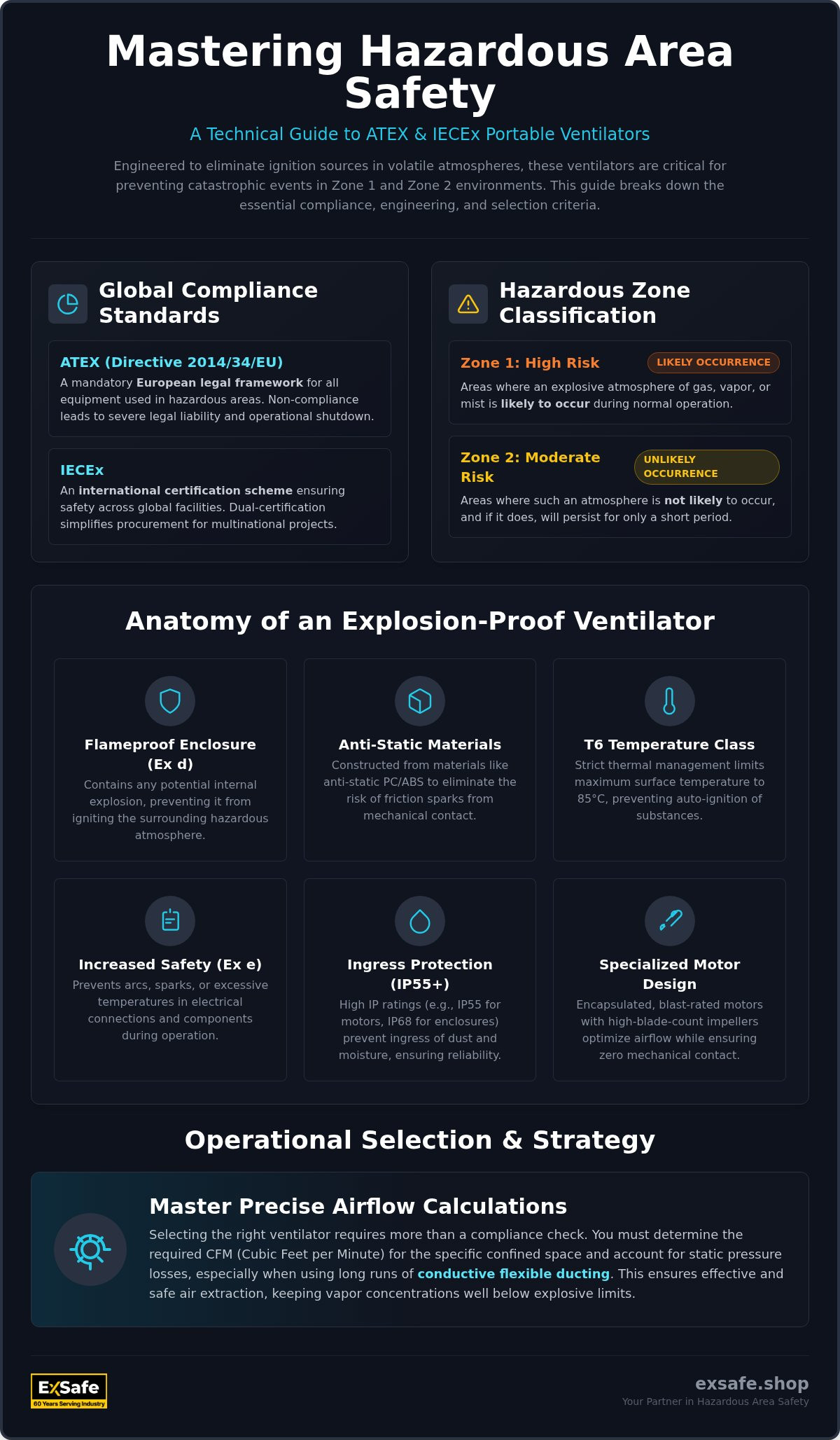
While ATEX is a mandatory European legal framework, IECEx is an international certification scheme. Dual-certified equipment ensures safety across global facility locations. This delivers peace of mind for safety managers overseeing international projects. Professional procurement focuses on specific certification strings such as Baseefa12ATEX0268 and IECEx BAS 16.0073X. These numbers confirm that the entire unit meets international standards. You can find fully compliant units in our ventilation collection. This interoperability simplifies safety management. It ensures your ATEX portable ventilator remains compliant regardless of the site's location.
Engineering Principles of Explosion-Proof Portable Fans
Engineering an ATEX portable ventilator requires a fundamental departure from standard ventilation design. Every component must mitigate ignition risks. We prioritize flameproof enclosures (Ex d) to contain internal explosions. We also utilize "Increased Safety" (Ex e) designs to prevent arcs or sparks in electrical connections. Adhering to OSHA ventilation standards ensures these mechanical safeguards meet rigorous industrial benchmarks. Thermal management is equally critical. A T6 temperature classification limits surface temperatures to 85°C. This ensures safe operation within ambient ranges of -20°C to +40°C. Robust Ingress Protection, such as IP55 for motors and IP68 for enclosures, guards against dust and moisture infiltration in volatile zones.
Materials Science in Hazardous Area Hardware
Standard steel is a risk due to friction sparks. We use aluminum or anti-static PC/ABS construction to eliminate this hazard. These materials are treated with chemical-resistant and flame-retardant coatings to withstand harsh industrial environments. Safety extends to the accessories. It's essential to use conductive ducting with a surface resistance ≤ 10⁶ Ω. This prevents dangerous static buildup during high-velocity air extraction. Precision in materials science is what separates industrial-grade hardware from standard consumer fans.
Motor Technology and Thermal Protection
The heart of the unit is an encapsulated, blast-rated motor. Professional models like the EFi75xx model utilize 17-blade impeller designs. These optimize airflow while maintaining a strict 2mm tip clearance to prevent mechanical contact. Shaft-operated on/off switches prevent internal sparking during activation. These motors are designed for continuous duty in high-risk zones, making the ATEX portable ventilator a reliable asset for long-shift operations. If you have specific technical requirements for your facility, you can request a technical consultation to ensure total compliance with your site's safety protocols.
Zone 1 vs. Zone 2 Requirements for Portable Ventilation
Safety managers must distinguish between Zone 1 and Zone 2 to prevent catastrophic ignition. Zone 1 defines areas where an explosive atmosphere is likely to occur during normal operation. In contrast, Zone 2 identifies areas where such atmospheres are unlikely or exist only for short periods. Selecting an ATEX portable ventilator for Zone 1 requires hardware that has undergone rigorous third-party testing and features reinforced sealing. Under-specifying by using Zone 2 equipment in a Zone 1 area to save costs is a critical safety failure. It creates a direct path to ignition. Precision in zone classification is the only way to ensure total regulatory compliance during safety audits.
Zone 1 Portable Extraction Fan Specifics
Zone 1 hardware must include explosion-proof switches, reinforced housings, and high-frequency certification. These units are essential for high-risk tasks like confined space entry, fuel tank cleaning, and chemical reactor maintenance. For specialized aerospace applications, the Aircraft Fuel Tank Ventilation Kit provides a certified solution for high-stakes maintenance. These kits ensure that even under normal operating conditions, the equipment remains a barrier against explosion. The technical delta between these zones is significant; Zone 1 units are built to withstand constant exposure to volatile vapors.
Zone 2 and Dust Zone (21/22) Considerations
Zone 2 equipment often utilizes non-sparking (Ex n) protection. While the risk is lower than Zone 1, the equipment must still prevent ignition during an abnormal occurrence. Dust Zones (21 and 22) introduce additional thermal constraints that safety officers must monitor. Equipment in these areas must maintain low maximum surface temperatures, such as T80°C, to prevent combustible dust from igniting. Integrating portable Zone 2 fans into wider facility safety protocols ensures comprehensive protection across all operational tiers. If you are unsure of your site's classification, contact our technical team for a compliance review to secure the correct hardware for your specific environment.
Operational Selection and Industrial Procurement Strategy
Selecting an ATEX portable ventilator requires precise atmospheric calculation. It's not just about hardware. It's about ensuring life-sustaining air exchange in high-risk zones. You must calculate the required Cubic Feet per Minute (CFM) based on room volume and the required air changes per hour (ACH). Static pressure is the most overlooked variable. Long ducting runs in confined spaces create significant resistance. High static pressure reduces effective airflow. Professional procurement accounts for these losses to maintain safety margins.
Technical Sizing for Hazardous Area Airflow
Calculating air changes in hazardous chemical storage follows a strict formula: Volume x ACH / 60. CFM is the volume of air moved per minute to ensure rapid contaminant removal. You must also factor in gas density. Heavier-than-air vapors require different extraction positioning. Each 90-degree turn in ducting significantly degrades airflow rates. Balancing velocity with worker safety is essential. High-performance units often operate at 89 dB @ 3ft. This trade-off ensures rapid venting while maintaining manageable noise levels for personnel.
The Quote-Request Workflow for Professional Procurement
Industrial safety demands more than a standard e-commerce transaction. Specialized suppliers provide the technical vetting required for complex site needs. Our quote-request system ensures that every ATEX portable ventilator matches your specific zone requirements. We prioritize batch tracking and serial number verification. This is vital for long-term safety audits and regulatory compliance. Direct access to full certification documentation prevents delays during inspections. For bulk orders or technical hardware specifications, Request a Professional Quote for ATEX Ventilation to secure your facility's safety infrastructure.
Securing Your Hazardous Operations
Industrial safety in volatile zones requires strict adherence to engineering standards and certification protocols. You've seen how material selection and motor encapsulation define the reliability of an ATEX portable ventilator. Relying on verified Zone 1 and Zone 2 hardware is the only way to mitigate the risk of catastrophic ignition. Precise airflow calculations and proper ducting management ensure that contaminants are removed efficiently. This maintains a safe atmosphere for your team during high-stakes maintenance and confined space entry.
As a global industrial and aerospace supplier, we provide hardware that meets the most rigorous international requirements. Every unit we supply carries full ATEX and IECEx certification to ensure your facility remains compliant during safety audits. It's essential to vet your equipment through a partner that understands the technical gravity of explosive environments. Our technical team is ready to assist with specialized requirements for petrochemical, offshore, or MRO projects. Request a Professional Quote for ATEX Ventilation today. Protect your workforce with certified precision.
Frequently Asked Questions
What makes a portable ventilator ATEX certified?
A portable ventilator achieves ATEX certification only when the entire unit is engineered to eliminate ignition sources. This includes the motor, housing, fan blades, and power switches. Every component undergoes rigorous third-party testing to meet EU Directive 2014/34/EU standards. Relying on partially certified hardware is a significant risk. Full unit compliance ensures the equipment remains safe while operating in volatile, high-risk industrial environments.
Can I use a Zone 2 blower in a Zone 1 environment?
No, using Zone 2 equipment in a Zone 1 area is a major safety violation. Zone 2 blowers aren't designed with the reinforced protection levels required for areas where explosive atmospheres are likely during normal operation. A Zone 1 ATEX portable ventilator features superior sealing and blast-rated components to handle higher risks. Under-specifying your hardware compromises site safety and will lead to safety audit failures during inspections.
How do I calculate the required CFM for hazardous area ventilation?
To determine the required CFM, multiply the total room volume by the necessary air changes per hour (ACH) and divide the result by 60. This calculation provides the air volume moved per minute for rapid contaminant removal. You must also account for static pressure loss, especially when using long runs of anti-static ducting. These losses significantly reduce effective airflow, making it vital to choose a fan with sufficient power.
Is special ducting required for ATEX fans?
Yes, safe operation requires anti-static or conductive ducting with a surface resistance of ≤ 10⁶ Ω. This prevents the dangerous buildup of static electricity caused by high-velocity air movement. Standard ducting can generate electrostatic sparks, which could trigger a catastrophic explosion in a hazardous zone. Integrating a compliant ATEX portable ventilator with the correct conductive accessories is the only way to ensure total system safety and regulatory adherence.
Why is a quote request necessary for industrial ventilation?
The quote-request system allows specialized engineers to vet your technical requirements before procurement. This ensures the hardware matches your specific zone classification and environmental hazards. It also provides the necessary documentation and batch tracking required for safety audits. This vetting process is essential for high-specification industrial orders where precision and compliance are non-negotiable. It helps safety managers avoid costly equipment errors and procurement delays.