

A single spark in a confined hazardous space isn't just a technical failure. It's a catastrophic risk that your safety protocols must eliminate. You know that managing cable clutter while maintaining strict ATEX compliance in a Zone 1 tank is a constant operational challenge. Relying on inferior or non-certified tank lighting kits puts your personnel and your facility at risk. Equipment failure in an explosive atmosphere is never an option.
We'll help you master the technical configuration of portable, linkable systems that provide high-visibility illumination. You'll learn how to select equipment compliant with the ATEX Directive 2014/34/EU and IECEx standards. This article previews the essential components of a compliant setup, including portable Wolf LinkEx™ floodlights and splitter boxes. We'll provide the technical clarity to ensure your next confined space entry is safe, compliant, and properly illuminated.
Key Takeaways
- Identify the mandatory ATEX Zone 1 and 21 certification requirements and the role of low-voltage transformers in mitigating electrical risks.
- Learn to configure modular tank lighting kits by selecting portable floodlights with output levels ranging from 4,788 to 9,576 lumens.
- Discover how to integrate specialized inspection lights featuring Directed Light Output technology for high-visibility, glare-free detail work.
- Understand industry-specific protocols for aerospace and petrochemical tank entry, ensuring equipment compatibility with IIA, IIB, and IIC gas groups.
Essential Components of an ATEX Tank Lighting Kit
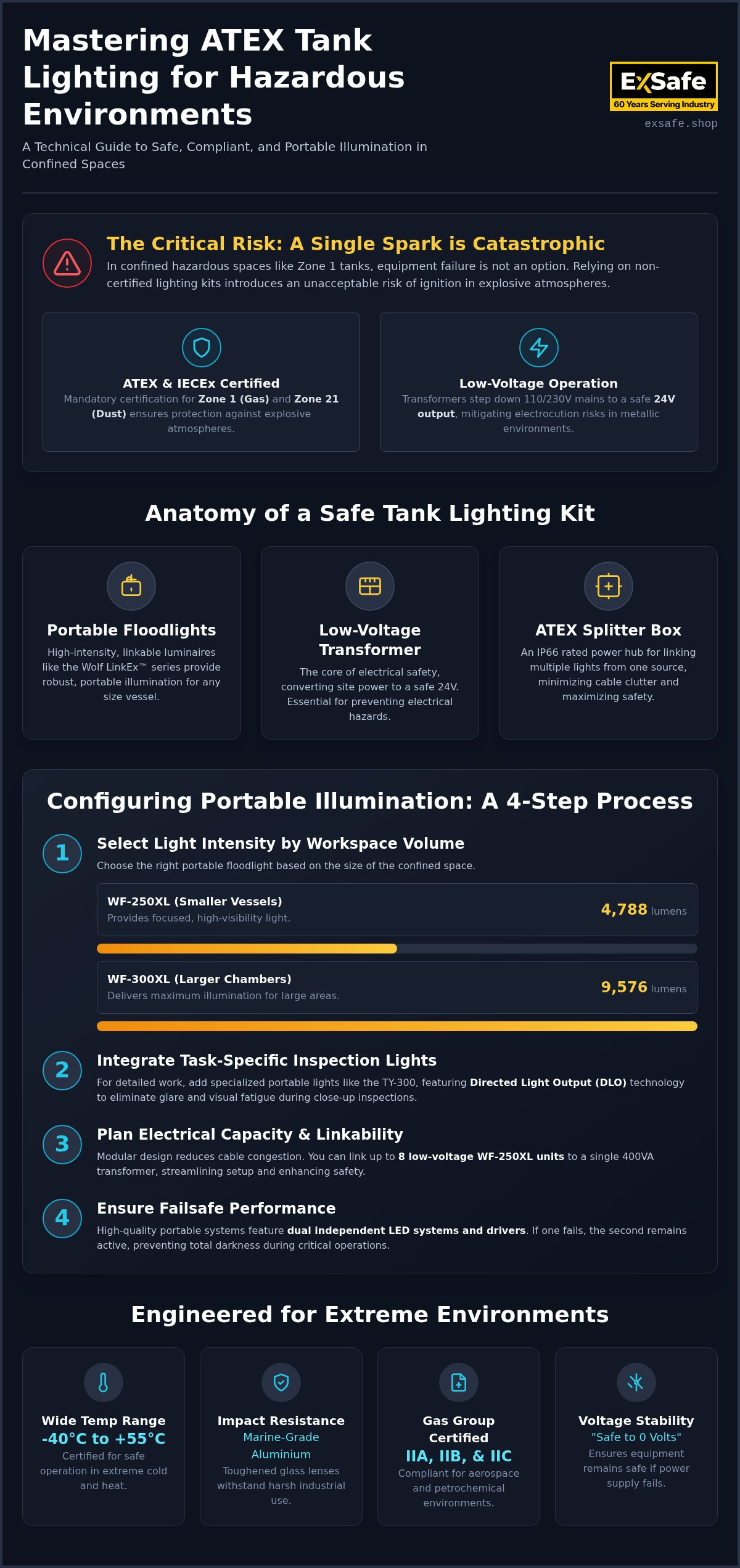
Safety in confined spaces depends on strict adherence to the ATEX directive. High-performance tank lighting kits must carry certifications for Zone 1 (Gas) and Zone 21 (Dust). This ensures protection against explosive atmospheres found in industrial vessels. Reducing electrical hazards requires low-voltage transformers. These units step down 230V or 110V power to a safe 24V output. This is a critical safety barrier for personnel in metallic environments where electrocution risks are heightened.
Fluctuating power levels can compromise equipment safety. The Wolf SOVI™ (Safe Optimal Voltage Indicator) system monitors these levels. It provides a clear visual alert if the system operates outside its certified range. Physical durability is equally vital. Use H07RN-F flexible cables or ECX™ extension cords rated for "Extra Hard Usage." These cords maintain integrity between -20°C and +40°C. They withstand the mechanical stress of being dragged through manways and over sharp edges.
Power Distribution and Splitter Box Safety
A robust Wolf ATEX Splitter Box (LL-260) serves as the system's power hub. It carries an IP66 rating and comes in GRP or 316 Stainless Steel. Technical compliance demands strict current management. The splitter box allows a 15A maximum input current. However, if ambient temperatures reach 55°C, you must reduce the input to 10A. The unit supports linkable configurations. By chaining portable luminaires from a central distribution point, you minimize cable clutter. This creates a safer, more efficient workspace for technical inspections. These modular tank lighting kits provide the flexibility required for complex vessel entries while maintaining absolute regulatory compliance.
Configuring Portable Illumination for Confined Spaces
Achieving optimal visibility in hazardous areas requires a structured approach to equipment selection. Step 1 involves assessing your workspace volume to determine the required light intensity. For smaller vessels, the WF-250XL provides 4,788 lumens of focused light. Larger chambers require the WF-300XL, which delivers 9,576 lumens. Step 2 integrates task-specific units into your tank lighting kits. The TY-300 inspection light uses Directed Light Output (DLO) technology. This eliminates glare during close-up work, ensuring technicians see every detail without visual fatigue.
Step 3 focuses on electrical capacity and linkability. You can link up to 8 low-voltage WF-250XL units to a single 400VA transformer. This modularity reduces entry point congestion while meeting OSHA hazardous location lighting standards for worker safety. Step 4 ensures failsafe performance. High-quality portable systems feature dual independent LED systems and separate drivers. If one driver fails, the second remains active. This prevents total darkness during critical maneuvers. If you've got questions about custom configurations, speak with our technical team to design a bespoke solution.
Task-Specific Lighting for Detailed Inspections
The TY-300 inspection light offers versatile positioning for complex tasks. It features integrated swivel hooks for handheld or suspended use. Durability is a core requirement for these portable units. Marine-grade aluminium enclosures and toughened glass lenses provide extreme impact and chemical resistance. These portable floodlights maintain safe operation across vast temperature ranges. They're certified for use from -40°C to +55°C. This robustness ensures reliability in the most demanding petrochemical and industrial environments.
Aerospace and Petrochemical Tank Entry Solutions
Aerospace and petrochemical environments present unique hazardous area challenges. In aerospace MRO, maintenance within aircraft wing tanks and fuselage vessels requires ultra-compact, high-intensity tank lighting kits. These confined areas often contain residual fuel vapors. Precision illumination is critical for spotting structural fatigue or leaks. Petrochemical vessel entry demands equipment certified for IIA, IIB, and IIC gas groups. Full compliance with the ATEX Directive 2014/34/EU is mandatory to prevent ignition in these volatile Zone 1 environments. You must verify that all portable luminaires meet these specific gas group requirements to maintain site safety during shutdown or inspection.
Reliable performance during maintenance hinges on voltage stability. A critical technical specification for both Low Voltage (LV) and High Voltage (HV) units is the "Safe to 0 Volts" requirement. This ensures that if the supply voltage drops significantly or fails entirely, the equipment remains safe. It prevents ignition hazards or dangerous thermal buildup. You can browse our full range of temporary lighting solutions to find units that meet these rigorous industrial standards for high-risk maintenance tasks.
Integrating Lighting with Portable Ventilation
Safe tank entry is impossible without synchronized illumination and gas clearance. We recommend combining your lighting setup with the EFi75xx blower/exhauster. This portable unit effectively clears hazardous vapors before and during technician entry. To prevent dangerous static buildup during illumination, always use anti-static flexible ducting. This integration mitigates the risk of electrostatic discharge in confined spaces where flammable gases may linger. For professional guidance on equipment compatibility and safety protocols, contact ExSafe for a bespoke tank lighting kit quote tailored to your specific facility requirements.
Securing Your Next Confined Space Entry
Safeguarding personnel in explosive atmospheres requires precision and certified hardware. You've seen how modular tank lighting kits provide high-visibility illumination while maintaining strict ATEX and IECEx Zone 1/21 compliance. By selecting linkable, portable solutions and integrating them with anti-static ventilation, you eliminate the risks of cable clutter and ignition. As an authorized distributor for Wolf Safety, ExSafe specializes in high-performance portable hazardous area hardware designed for the most demanding technical environments. We provide the peace of mind that comes from professional-grade protection. Don't leave your facility's safety to chance with non-certified equipment. Request a Custom Tank Lighting Kit Quote today to ensure your team has the reliable tools they need for a successful entry. Your commitment to safety starts with the right technical partnership.
Frequently Asked Questions
What is the difference between Zone 1 and Zone 2 tank lighting kits?
Zone 1 tank lighting kits are certified for environments where explosive atmospheres are likely to occur during normal operations. Zone 2 equipment is only rated for areas where such hazards are infrequent or short-lived. Zone 1 hardware undergoes more stringent testing and features robust protection to ensure it remains safe even in the presence of a constant combustible atmosphere.
How many LED floodlights can I link to a single ATEX transformer?
You can link up to 8 low-voltage WF-250XL floodlights to a single 400VA transformer. This specific limit maintains the electrical integrity of the system and prevents overloading the power distribution source. Always calculate the total current draw to ensure it doesn't exceed the 15A maximum input limit of the splitter box to maintain site safety.
Why is SOVI™ technology critical for tank lighting safety?
SOVI™ technology is critical because it provides an immediate visual warning if the equipment operates outside its certified voltage range. If the voltage drops below the safe threshold, the system alerts the operator. This prevents the hardware from operating in an unsafe state, which is vital for maintaining compliance in explosive Zone 1 or Zone 21 environments.
Can I use standard extension cords with my tank lighting kit?
No, standard commercial extension cords are strictly prohibited in hazardous areas due to ignition risks. Compliant tank lighting kits require specialized ECX™ extension cords or H07RN-F cables. These are built for "Extra Hard Usage" and are certified to operate safely between -20°C and +40°C. Using non-certified cabling creates a significant risk and violates safety regulations.