

A single spark in a Zone 1 environment is more than an equipment failure; it's a catastrophic safety breach. You understand the pressure of maintaining breathable air in hazardous areas while ensuring every piece of gear meets strict ATEX standards. Selecting a portable extraction fan Zone 1 certified often feels like a choice between heavy, immobile units and underpowered fans that fail to move enough air. It's a high-stakes balance; there's no room for error or technical ambiguity when lives are on the line.
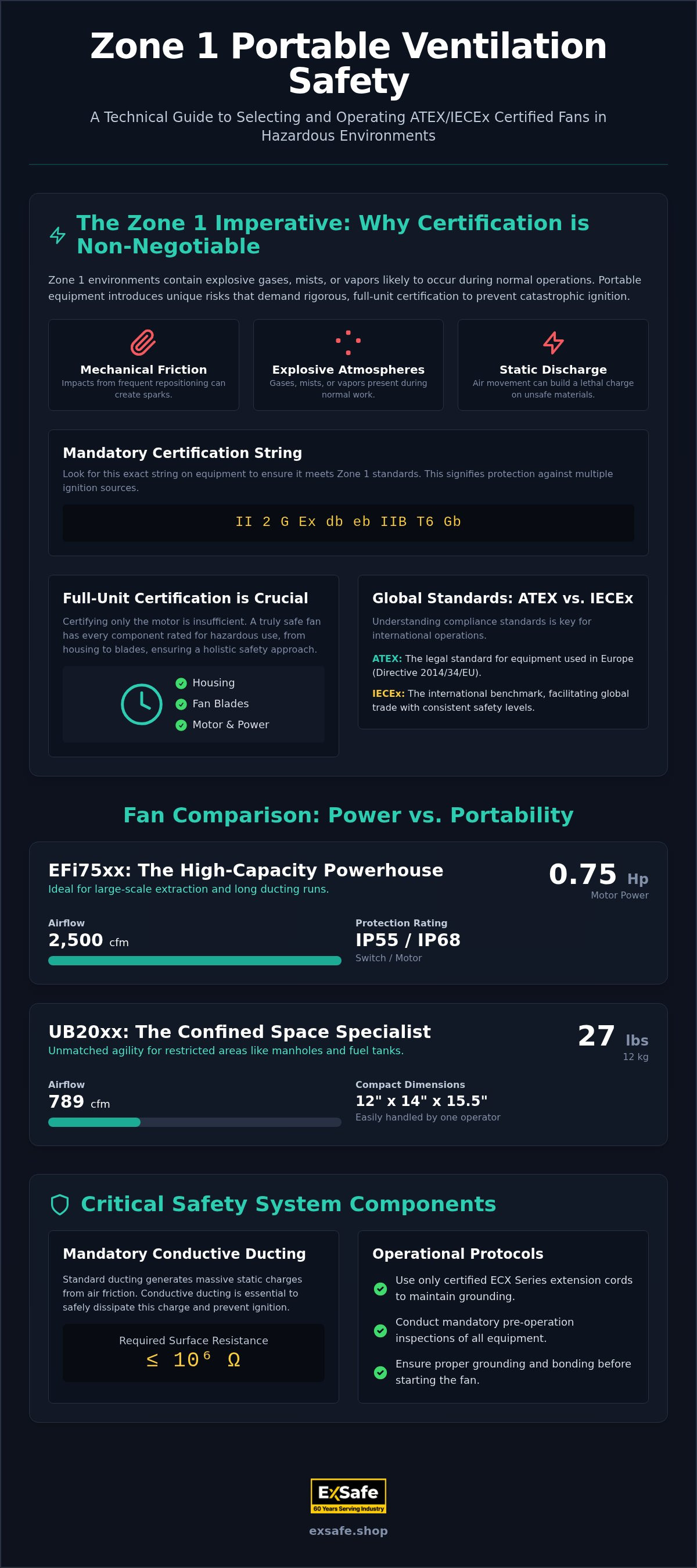
This guide simplifies the selection process by comparing high-performance ventilation solutions designed for the toughest industrial settings. We examine the technical specifications of industry-leading models like the RAMFAN EFi75xx and UB20xx. You'll learn how to identify true certifications, such as II 2 G Ex db eb IIB T6 Gb, and why durable anti-static construction is a mandatory requirement for safe operation. We provide the technical clarity needed to select equipment that protects your team and satisfies global safety protocols with absolute precision.
Key Takeaways
- Identify why Zone 1 environments demand full-unit ATEX/IECEx certification to mitigate ignition risks from mechanical friction and static discharge.
- Select the right portable extraction fan Zone 1 model by evaluating the lightweight portability of the UB20xx against the 0.75 Hp powerhouse EFi75xx.
- Prevent hazardous static build-up by integrating mandatory conductive ducting with a surface resistance of ≤ 10⁶ Ω into your ventilation setup.
- Maintain site compliance by following strict operational protocols, including the use of certified ECX Series extension cords and mandatory pre-operation equipment inspections.
Why Zone 1 Certification is Mandatory for Portable Extraction
Zone 1 identifies an environment where explosive gases, mists, or vapors are likely to occur during normal daily operations. In these hazardous locations, safety is non-negotiable. Portable equipment introduces specific dangers that fixed installations don't face. Frequent repositioning increases the risk of mechanical impact and friction. It also creates opportunities for static discharge if the housing isn't properly grounded or manufactured from conductive materials.
A compliant portable extraction fan Zone 1 must satisfy rigorous engineering requirements. We demand exact certification strings like II 2 G Ex db eb IIB T6 Gb. General industrial fans are fundamentally unsafe for these tasks. They lack spark-proof motors and rely on housings that invite static accumulation. Professional-grade units like those in our ventilation collection use specialized PC/ABS anti-static construction. This material ensures that moving air doesn't create a lethal ignition source through surface resistance.
ATEX vs IECEx: Navigating Global Standards
Regulatory compliance depends on your geographic location and industry requirements. The ATEX Directive 2014/34/EU is the legal standard for equipment used in Europe. IECEx serves as the international benchmark, facilitating global trade by ensuring consistent safety levels. Look for "Full-Unit" certification. Some manufacturers only certify the motor, leaving the rest of the assembly at risk. A truly safe portable extraction fan Zone 1 carries certification for the entire unit, including the housing, fan blades, and power components. This holistic approach ensures every part of the system is engineered to prevent explosions.
Comparing Top Portable Extraction Fans: EFi75xx vs. UB20xx
Selecting the correct portable extraction fan Zone 1 depends on the volume of the space and the accessibility of the entry point. You must balance raw airflow against the physical limitations of the site. Compliance with OSHA safety protocols requires ventilation systems that effectively mitigate hazardous concentrations. We focus on two primary models that define the industry standard for performance and portability.
EFi75xx: Technical Deep Dive
The EFi75xx (EB7201XX) is our high-capacity powerhouse. It features a 0.75 Hp motor and a specialized 17-blade impeller designed for maximum pressure efficiency. This unit delivers 2,500 cfm (4,250 m³/hr) of free air, making it suitable for large-scale extraction projects. Its startup current is 37 A, settling to a running current of 8.8 A at 115V. Protection is paramount; the fan includes an IP55-rated switch enclosure and IP68 motor protection to withstand moisture and dust in heavy industrial use.
UB20xx: Compact Confined Space Specialist
When entries are tight and weight is a factor, the UB20xx (EF7002) is the preferred portable extraction fan Zone 1. It weighs only 27 lb (12 kg), allowing for easy manual transport by a single operator. The 0.33 Hp motor delivers a reliable 789 cfm (1,341 m³/hr). With compact dimensions of 12 x 14 x 15.5 inches, it's the ideal choice for aircraft fuel tank ventilation and small manhole entries. It provides essential airflow without obstructing the workspace.
Choosing between these models involves a simple trade-off. The UB20xx offers unmatched agility for restricted areas. The EFi75xx provides the volume needed for larger atmospheres or longer ducting runs. If you aren't sure which unit fits your specific airflow requirements, speak with our technical team for a precise recommendation based on your site dimensions.
Critical Accessories: Conductive Ducting and Static Control
A certified portable extraction fan Zone 1 setup is only as safe as its weakest link. Moving air creates friction. In standard non-conductive tubes, this friction generates massive static charges. Without a path to ground, these charges accumulate until they find an ignition source. The HSE Hazardous Area Classification standards require strict control over electrostatic discharge in explosive atmospheres to prevent catastrophic accidents.
Mandatory conductive ducting must maintain a surface resistance of ≤ 10⁶ Ω to ensure safe dissipation. We provide the ECKO Flex™ Anti-Static Duct to meet this technical requirement. It's built from reinforced polymer with an integrated steel helix wire for maximum durability and grounding continuity. Don't risk site safety with generic hoses that haven't been tested for hazardous environments. You can browse ATEX conductive ducting solutions to find the correct diameter for your equipment.
Calculating Airflow Loss with Ducting
Performance specs often highlight "free air" delivery, but real-world applications involve resistance. Attaching ducting immediately reduces effective airflow. The EFi75xx delivers 2,500 cfm of free air; however, this capacity drops to 1,664 cfm when operating with one 15 ft duct and a single 90° turn. You must account for these losses to ensure the atmosphere remains safe for your team.
Consider these technical factors for your extraction plan:
- Duct Length: Extending from 15 ft to 25 ft increases static pressure and lowers cfm.
- Bends and Turns: Each 90° turn creates significant turbulence and energy loss.
- Reducers: Using 12 in to 8 in adapters allows access to specialized entries but forces the motor to work against higher back-pressure.
Calculating these losses is essential for maintaining safe oxygen levels and removing toxins. If you're unsure how your ducting configuration will affect your portable extraction fan Zone 1 performance, contact our technical specialists for a comprehensive airflow assessment.
Safety Protocols for Operating Portable Fans in Zone 1
Safety protocols for a portable extraction fan Zone 1 are the final line of defense against ignition. Site safety begins with a thorough pre-operation inspection. You must check the fan blades, guards, and the PC/ABS anti-static housing for any shipping damage or debris. Even a minor crack in the housing compromises the unit's ability to dissipate static charges safely. Verify that all fasteners are tight and that the fan rotates freely without contact.
Power connections must match the hazard level of the environment. Standard industrial plugs are unacceptable in these zones. Use only ATEX/IECEx certified extension cords, such as the ECX Series, to maintain the integrity of the II 2 G Ex db eb IIB T6 Gb certification. Placement is equally critical. Ensure the unit is stable on a level surface. Never move the ventilator while the fan is in operation. This prevents mechanical stress on the motor and avoids potential friction between the blades and the housing. You can Request a Quote for Zone 1 Ventilation Systems to ensure your site is equipped with fully compliant power and extraction gear.
Maintenance and Chemical Precautions
Proper maintenance preserves the life and safety rating of your equipment. Cleaning requires specific attention to chemical compatibility. Never use solvents containing hydrocarbons, such as MEK or Acetone, on the motor, cables, or housing. These chemicals degrade the anti-static properties of the materials and damage critical seals. Use only approved cleaning agents that won't compromise the integrity of the conductive surfaces.
Keep the motor dry at all times. Never immerse or directly spray the unit with liquids during cleaning. Finally, respect the engineering of the flame-proof joints. These components are precision-machined to quench internal explosions. They are not intended for field repair. If a joint is compromised, the unit must be serviced by an authorized technician to maintain its safety rating and protect your personnel.
Secure Your Hazardous Workspace with Certified Ventilation
Ensuring site safety requires more than just moving air. It demands equipment that meets exact ATEX and IECEx standards for Zone 1 and 2 environments. We have explored how high-performance units like the EFi75xx and UB20xx provide the necessary airflow while mitigating the risks of mechanical friction and static discharge. Integrating mandatory conductive ducting and following strict operational protocols are the final steps in protecting your personnel from catastrophic ignition events.
Every portable extraction fan Zone 1 solution we provide is backed by Euramco Group's global support and technical expertise. These systems offer versatile positive pressure and exhaust capabilities to handle diverse industrial challenges across the globe. Precision engineering and durable PC/ABS construction ensure your ventilation remains reliable under the most demanding conditions. Don't compromise on safety when specialized, certified protection is available for your team.
Request a Custom Quote for Zone 1 Ventilation Equipment to secure your facility today. Our technical specialists are ready to help you implement a fully compliant safety strategy with the industry's most dependable tools.
Frequently Asked Questions
Can I use a portable extraction fan in a mine with firedamp?
No, these fans are not certified for use in mines susceptible to firedamp. While they provide protection in industrial Zone 1 settings, mining environments require specific Group I certifications for underground hazards. Always verify your site classification before deployment. Using unrated equipment in gassy mines creates an immediate explosion risk. Standard industrial units don't meet the unique safety requirements for underground mining operations.
What is the difference between Zone 1 and Zone 2 portable fans?
The primary difference is the frequency of the explosive hazard and the required protection level. Zone 1 environments are areas where explosive atmospheres are likely to occur during normal operation. A portable extraction fan Zone 1 must meet higher safety standards than Zone 2 units, which are for areas where hazards are unlikely. Zone 1 equipment undergoes more rigorous testing to prevent ignition during frequent exposure to volatile gases.
Do I need special ducting for a Zone 1 extraction fan?
Yes, you must use mandatory conductive or anti-static ducting in any Zone 1 environment. Standard plastic ducting accumulates static electricity as air moves through the system, creating a lethal spark risk. Ensure your ducting maintains a surface resistance of ≤ 10⁶ Ω. Professional solutions like the ECKO Flex™ Anti-Static Duct utilize reinforced polymers and steel helix wires to safely dissipate these charges to the ground.
Can I use an extension cord with my Zone 1 extraction fan?
You can only use extension cords that carry full ATEX or IECEx certification for hazardous locations. Standard commercial cords aren't sealed against gases and can become an ignition source. We recommend using ECX Series certified extension cords to maintain the integrity of your power bridge. Ensure all connections are secure and verify that the cord's voltage and amperage ratings are compatible with your specific ventilation equipment.
How do I maintain the ATEX certification of my portable fan?
Certification maintenance requires strict adherence to manufacturer cleaning protocols and service restrictions. Never use solvents containing hydrocarbons like Acetone or MEK on the motor or housing. These chemicals destroy anti-static properties. Additionally, flame-proof joints are precision-engineered and aren't intended for field repair. Any structural compromise or motor failure must be handled by an authorized technician to ensure the portable extraction fan Zone 1 remains safe and compliant.